Behind the Design
Design 5
Erwin Hauer began exploring modular sculpture in 1950 in Austria and installed his first light-diffusing screens in churches around Vienna. His screens and sculptures quickly garnered attention abroad, leading to a two-year stint at the Rhode Island School of Design on a Fulbright scholarship. Following his time at RISD, Hauer was invited by Josef Albers to join the faculty of Yale University, where he taught until 1990.
In 2004, there was renewed interest in Hauer’s modular walls and light-diffusing screens following the publication of the first book written about the collection Erwin Hauer: Continua, Architectural Screens, and Walls.
Leading up to the book’s publication, Hauer partnered with former student Enrique Rosado to form Erwin Hauer Studios and to start production of some of his earlier designs, adapting his Continua series and other light-diffusing screens using new technology to enable larger-scale production.
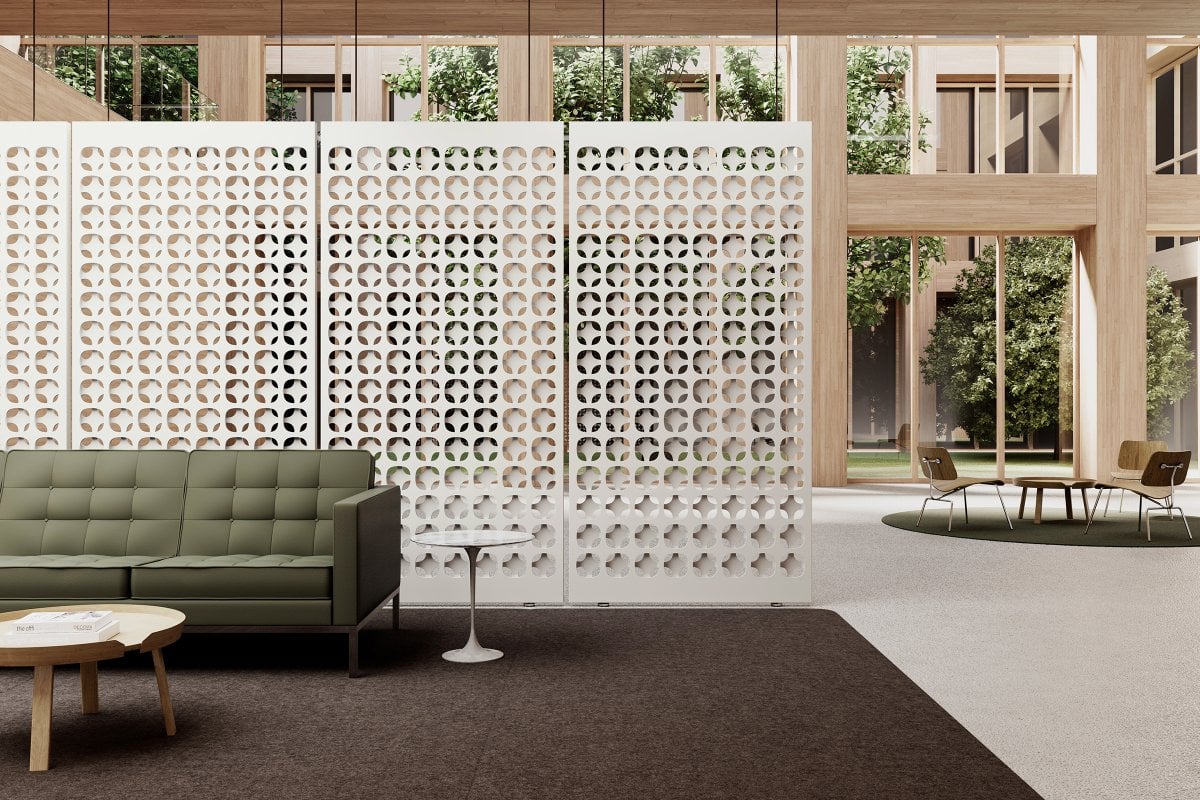
For the next fifteen years, the pair worked to further develop the collection and install Continua screens in institutions including the Museum of Fine Arts in Boston, the Standard Hotel in New York City, the World Bank in Washington, DC, and countless private homes in the US and abroad.
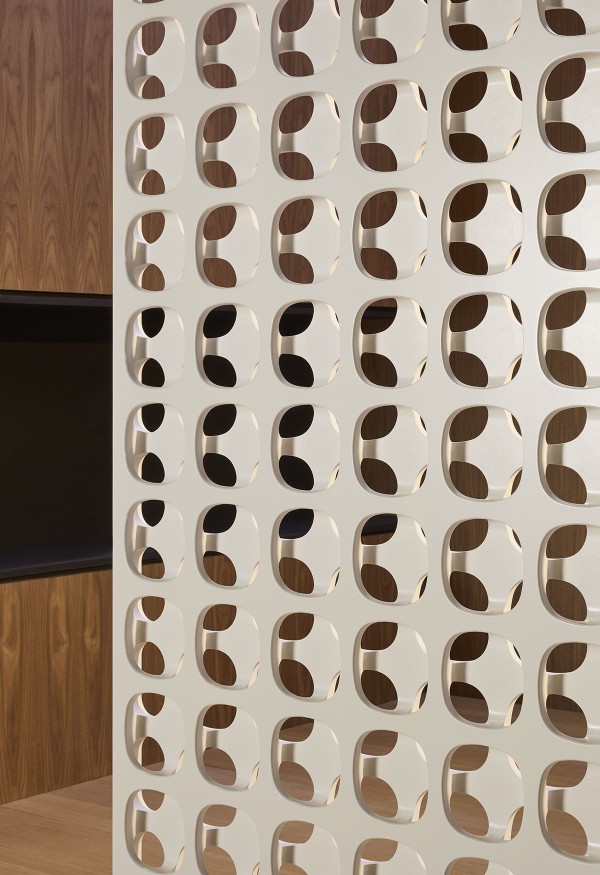
Design 5 belongs to a family of designs Hauer developed between 1950 and 1959 while exploring continuity and ‘potential infinity’ in sculpture. This idea was derived from his studies of the biomorphic form and was later reinforced when he discovered the works of abstract artist and sculptor Henry Moore. In 1950, while studying Moore’s saddle surfaces (named for their resemblance to a horse saddle), Hauer developed Design 1. And while Moore ‘tamed’ his saddle surfaces by limiting them to a single form, Hauer leaned into the infinite surface, expanding his sculptural forms into repeating patterns. For the next nine years, he would explore a number of these patterns, developing light-diffusing screens while still an art student in Vienna. This collection, later known as Continua, would become the sculptor’s most prolific body of work—a family of designs that share a common geometry. It was in Vienna that the potential for these works’ architectural application emerged.
The recognition of this body of work is what ultimately led to Hauer’s move to the U.S., where he received a Fulbright Grant and garnered the attention of the Museum of Modern Art and several noted architects, including Philip Johnson, Florence Knoll, and Marcel Breuer. While he had constructed most of the surfaces himself in Austria, he soon licensed production and marketing of his screens to Art for Architecture in New York.
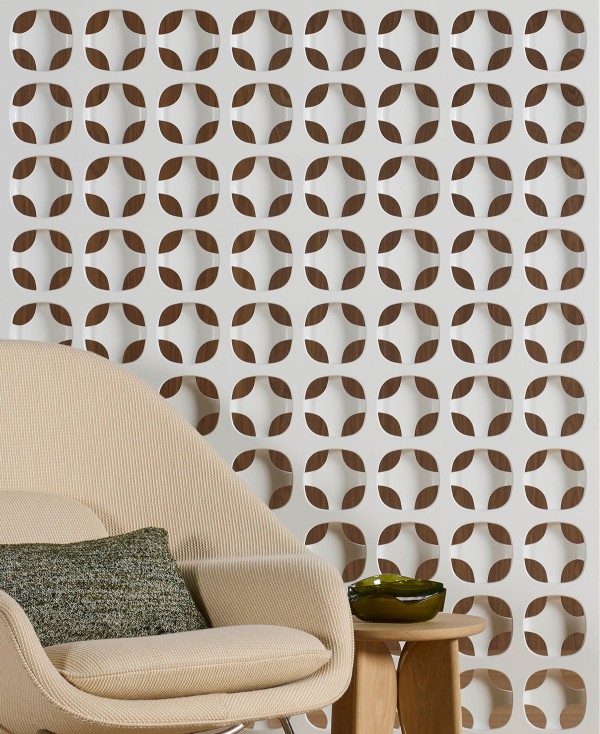
In 1956, Hauer was invited to join Joseph Albers as a postgraduate and later a faculty member of the Department of Design at Yale University School of Art. There, he continued his studies of the infinite surface and created additional architectural screens, including Design 4 and Design 5. Design 5 Hauer described as an evolution of Design 4, but with "improved light-diffusing properties."
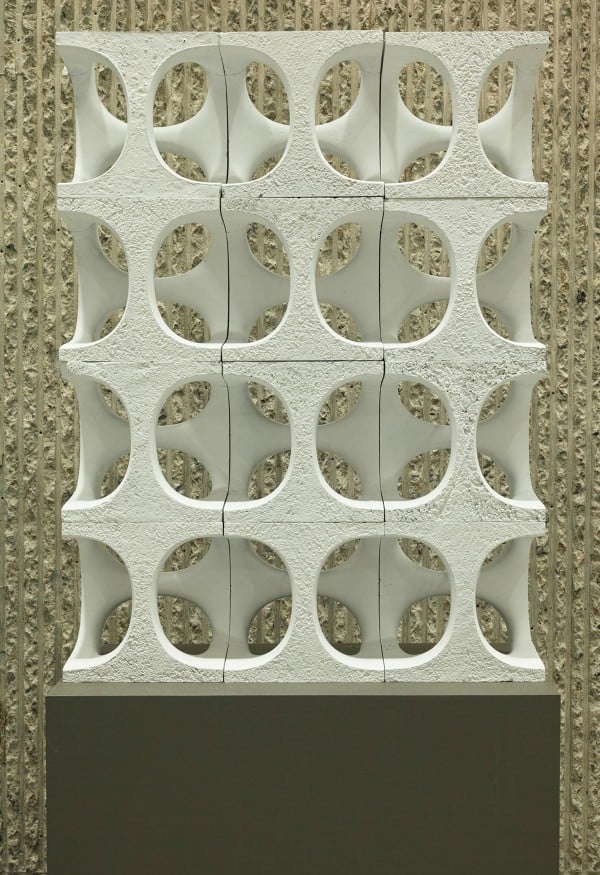
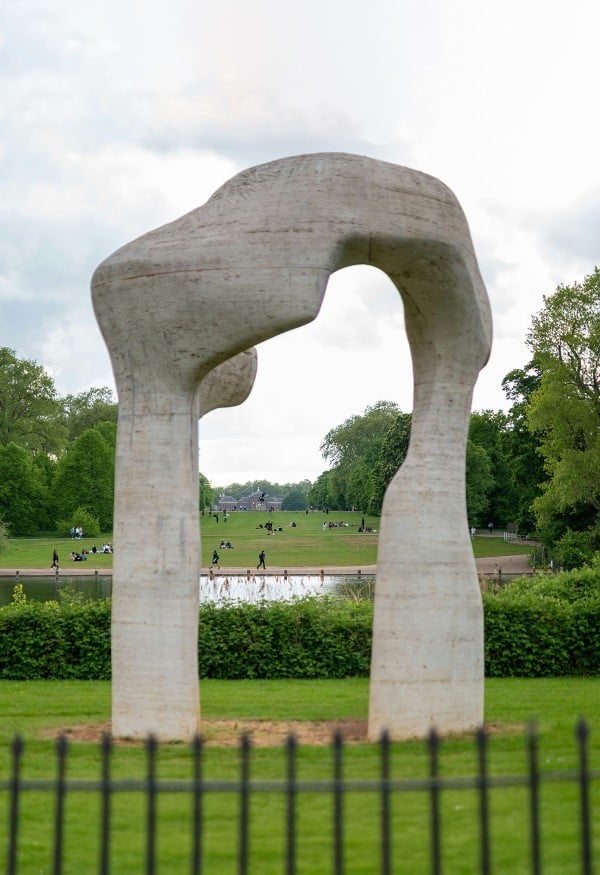
“Continuity and potential infinity have been at the very center of my sculpture from early on. I derived the notion of a continuous surface primarily from my studies of biomorphic form. This was greatly reinforced by my first encounter with the works of Henry Moore, who combined the dominant continuity of surface with an unprecedented cultivation of interior spaces with his sculpture.”
“This is a limited portion of a family tree that may be very large. I have continued to unexpectedly stumble upon other manifestations of some of its branches, and I have also deliberately generated further derivations from it in subsequent works. This family tree grows from the staggered circle pattern that has a rather pervasive presence in various cultures around the world.”
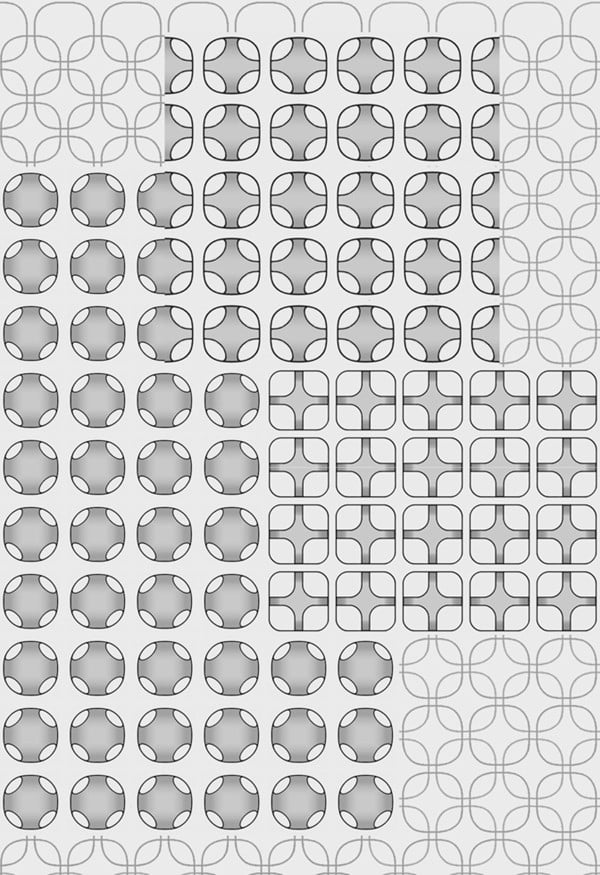
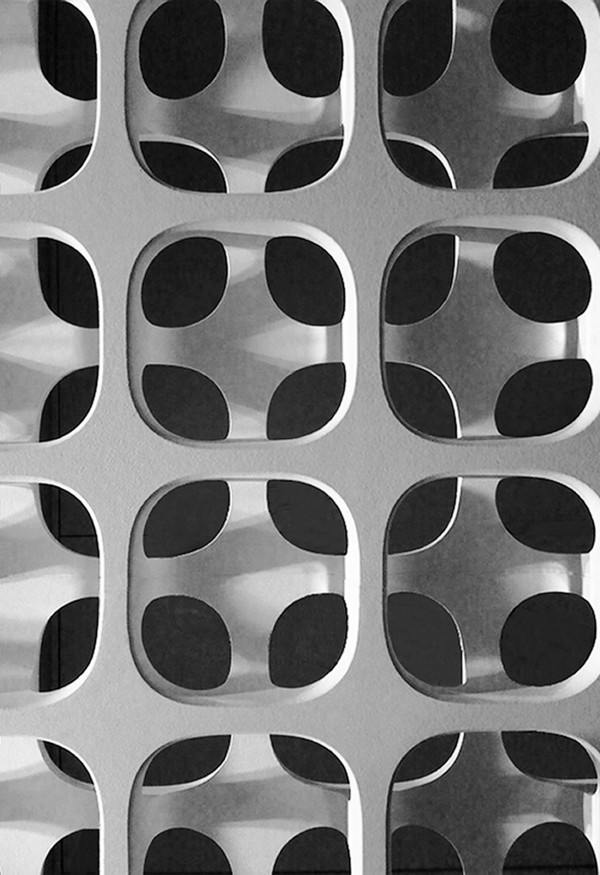
“The complex screen transforms the light so completely that the wall appears to radiate far more light than would pass through a flat plane with comparable holes punched through it.”
“When the light comes from behind, it emphasizes the individual spaces contained within each module. Suffused with luminescence, these often little-noticed interior voids come to our attention for the first time, revealing wonderful and unfamiliar visual effects.”